Jungle Bird Manor · Game guide
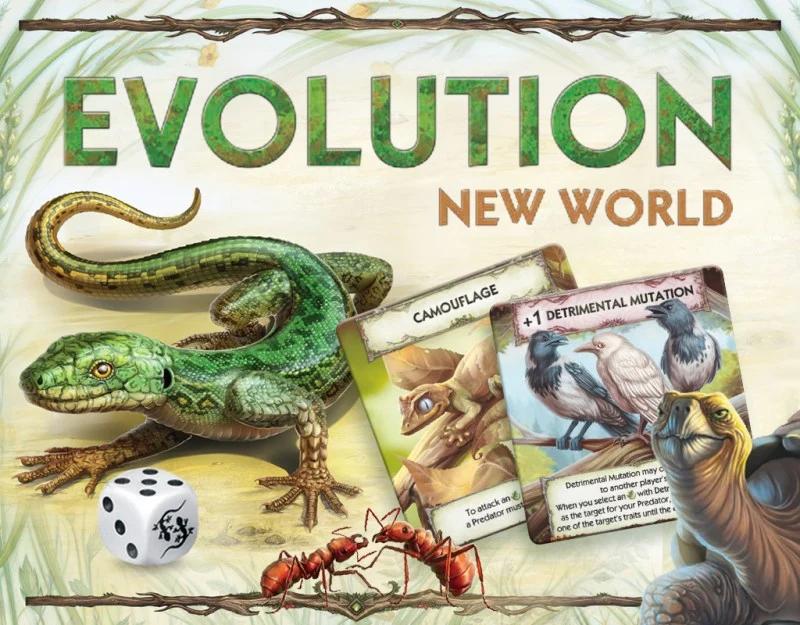
Evolution: New World
Create animals, add useful traits and help them survive a changing world.
Your aim
Score the most points from animals and traits surviving the sixth epoch.
Evolution cards become animals or traits attached to them. Each epoch is one round: develop animals, reveal food, feed them, then remove animals that cannot survive.
Set up
Before the first turn
- cards each
- 6
- epoch cards
- 6
- faceup Area per player
- 1
Build the area row
Shuffle Areas. Set aside 6 facedown for the epochs; reveal one per player in a row. Put unused Areas back.
Deal & prepare supplies
Shuffle Evolution cards; deal 6 each. Set food, fat and shelter tokens nearby. Choose a first player.
Play
At the table
- Play animal or trait cards
- Refresh food and Areas
- Take feeding actions
- Remove unfed animals; draw cards
Develop
Clockwise, play 1 card: facedown as an animal, or faceup as a trait on an animal. Passing ends your development for this epoch.
Refresh the world
Reveal the next Area at the left. Fill every printed food/shelter space with its token; do not double-fill occupied spaces.
Feed, shelter or hunt
Clockwise, choose one feeding action below. Continue until everyone must pass. A hungry animal needs 1 food + its printed extra requirements.
Extinction & new cards
Remove unfed/poisoned animals unless a trait saves them. Clear food and shelters; keep stored fat. Discard the rightmost Area; pass first player clockwise.
Choose one feeding action when your turn comes
During the feeding phase, players alternate taking one action at a time until everyone must pass.
| Action | Effect |
|---|---|
| Take food | Give 1 red food to a hungry animalChoose an Area that the animal’s traits allow it to reach. |
| Take shelter | Give an animal 1 green shelter tokenAn animal can have at most one shelter; it protects against hunting. |
| Hunt | Use a hungry animal with CarnivorousChoose prey without shelter, check its defenses, then rotate the Carnivorous trait. |
Rules reference
Use these rules when the matching situation comes up.
Hunting
A hungry carnivore attacks once per epoch. Choose prey without shelter whose defenses your predator can overcome; rotate Carnivorous.
- Resolve prey defenses. On success discard prey and attached traits, then take up to 2 blue food, limited by hunger.
- Fat Tissue may store excess food as fat. Traits can alter this sequence; their printed text applies.
Next epoch’s hand
From the current first player, draw 2 cards + 1 per surviving animal. Then discard down to 6 cards.
- With no surviving animals, refill your hand to 6 instead. Pass first-player token clockwise.
- Do not renew or draw after the final extinction. An empty Evolution deck is reshuffled from discards.
Trait placement
Traits are normally attached to your own animals. A card with two traits supplies just one: expose the chosen end. No duplicate trait on one animal.
- Paired traits connect neighboring animals. Parasite can be placed on an opponent as its text permits.
- For special food, defense and pairing effects, apply the text on the trait and the included reference.
Finish & score
After the sixth extinction → score
Each survivor scores 3, each attached trait 1, plus printed + 1/+ 2 food-requirement bonuses. Count paired traits once. Highest total wins; ties favor more surviving animals.
The essentials for a first game. Use the official rules for full setup diagrams, card effects and special cases.
See it played
Watch & learn
A visual walkthrough for your first game.
Keep the game moving
Quick questions
Is this the North Star game called Evolution?
No. Use Evolution: New World rules; the other Evolution has different components and rules.
Can I play a card as either an animal or a trait?
Yes. Use it facedown as a new animal, or attach its faceup trait legally to an existing animal.
Can a carnivore always attack?
No. Apply predator and prey traits, defenses and feeding restrictions from the trait reference.
What happens to an unfed animal?
It dies during extinction. Its traits leave with it; surviving animals determine your next hand.
Rules & edition reference ↗The booklet in your box takes precedence if your printing differs.